
Overview
The CTD Tree Tab is the primary screen for viewing eCTD v4.0. It represents the Leaves submitted in submissionunit.xml as a tree structure. This corresponds to the screen for opening index.xml in v3.2.2.
Select the ContextOfUse, etc., you want to view on the left, and browse its information on the right.
Screen Layout
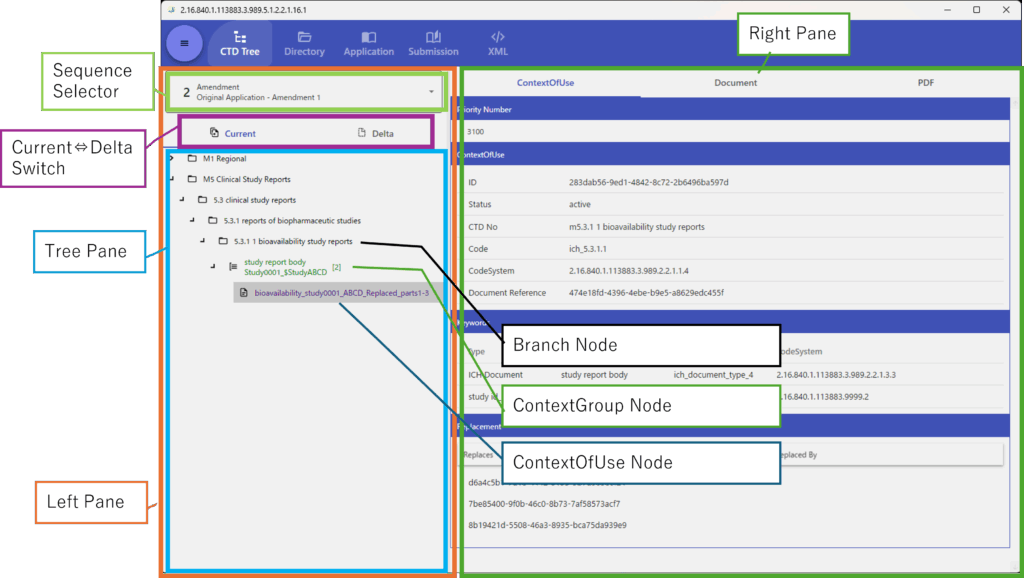
- Left Pane
-
The area on the left.
Contains the Sequence Selector, Current–Delta Switch, and Tree Pane.
- Sequence Selector
-
Select the Sequence to view in this tab. It is a dropdown list.
- Current–Delta Switch
-
Switch between Current mode, which displays the combined lifecycle information up to the selected Sequence, and Delta mode, which shows only the files submitted in the selected Sequence.
- Tree Pane
-
Displays the ContextOfUse, etc., of the selected Sequence in a tree structure.
- Right Pane
-
Shows the information of the item selected in the Left Pane.
- ContextOfUse Node
-
A Node representing a ContextOfUse.
- ContextGroup Node
-
A Node representing a ContextGroup.
- Branch Node
-
A Node required to arrange ContextOfUse within the CTD Tree structure.
Selecting the Sequence to View
Select the Sequence you want to view from the Sequence Selector.
All Sequences belonging to the Application currently being viewed are listed in the combo box, so choose one from the list.
Selecting the Viewing Mode
Select the viewing mode using the Current–Delta Switch.
- Current Mode
-
Displays the state reflecting all operations up to the selected Sequence.
- Delta Mode
-
Displays only those ContextOfUse with changes (submission, deletion, replacement) in the selected Sequence.
Tree Pane
The top level of the tree consists of Branch Nodes for M1, M2, M3, M4, and M5, with ContextOfUse Nodes at the lowest level.
Each ContextOfUse Node always belongs to a ContextGroup Node, and each ContextGroup Node always belongs to a Branch Node.
ContextOfUse Node
Each ContextOfUse Node corresponds to one ContextOfUse.
When selected, the Right Pane displays the information for the corresponding ContextOfUse.
ContextGroup Node
A Node corresponding to a ContextGroup. A ContextGroup groups ContextOfUse that share the same CTD No. and all Keywords.
When selected, the Right Pane displays the information for the corresponding ContextGroup.
Displaying a ContextGroup Node
A ContextGroup Node displays the Keywords and the number of Keywords held by the ContextOfUse belonging to that ContextGroup to distinguish between different ContextGroups.
In the example on the right, the Keywords Good Drugs 123 and Product 123 are displayed, with the total number of Keywords shown as [2].

However, if all ContextGroup Nodes at the same level share the same Keyword, that Keyword will not be displayed for the ContextGroup Node.
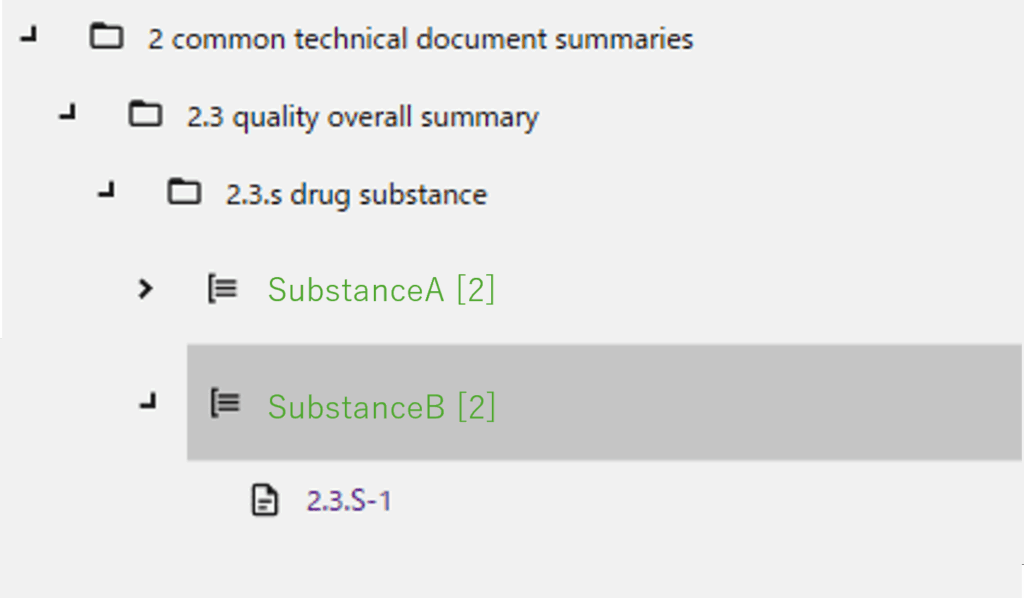
In the example on the right, the ContextGroup Node labeled SubstanceA[2] is shown to have two Keywords.
Specifically, it has the following two Keywords:
・substance: SubstanceA
・manufacturer: ManufacturerX
Despite this, only SubstanceA is displayed because the ContextGroup Node labeled SubstanceB directly below it also has manufacturer: ManufacturerX.
The fact that it is manufacturer: ManufacturerX is common information shared by all ContextGroup Nodes directly under 2.3.s drug substance and cannot serve as information to distinguish between ContextGroup Nodes.
Branch Node
When selected, it displays the information for all ContextOfUse nodes under this node collectively in the right pane.
Right Pane
ContextOfUse
If the Document referenced by the selected ContextOfUse Node is a PDF, the PDF Tab appears; if it is XML, the XML Tab appears.
The PDF Viewer settings are reflected in the PDF rendering engine of this PDF Tab.
